
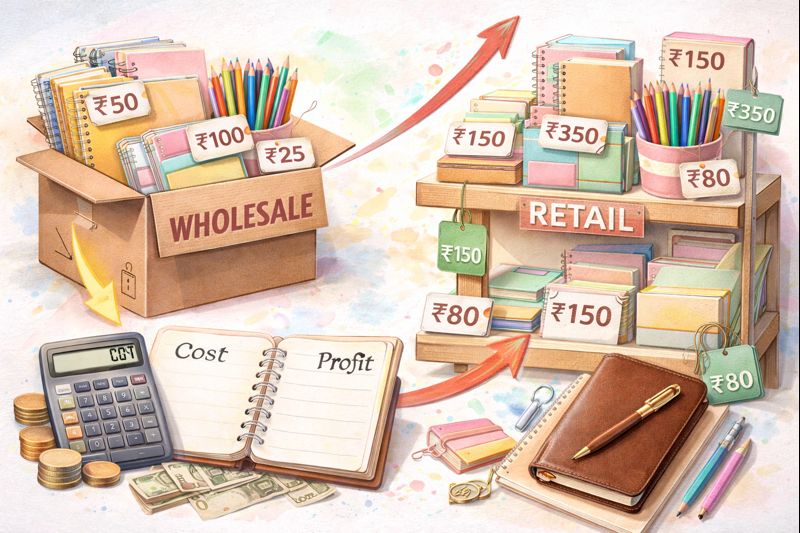
Can you really make 70% profit selling notebooks?
The short answer:
👉 Yes — but only if you understand how stationery business profit margin really work.
Many people start a stationery business thinking:
“I buy a notebook for ₹100 and sell it for ₹250. That’s 60% profit.”
But in reality, profit margin is much more than buying cheap and selling expensive. You must account for printing, packaging, shipping, platform fees, marketing, your time, and overhead costs. If you’re exploring ways to expand or start your own venture, these profitable stationery business ideas can help you choose the right direction.
If you are planning:
- A stationery shop from home
- An online stationery business
- A handmade stationery brand
- A digital stationery business
Then understanding stationery business margin is the difference between building a profitable business and running into losses.
In this guide, you will learn:
- Realistic profit margins by product type
- How to calculate your margin correctly
- Where most stationery sellers lose money
- Pricing strategies for 50–80% margins
- How to increase your margins by 20–40%
Table of Contents
1. Understanding Stationery Business Margins (The Basics)
What Is Stationery Business Profit Margin?
Profit margin shows how much of your selling price is actual profit.
Formula:
Profit Margin (%) = (Selling Price – Total Cost) ÷ Selling Price × 100
Example:
Notebook selling price = ₹500
Total cost = ₹200
Margin = (500 – 200) ÷ 500 × 100 = 60%
Gross Margin vs Net Margin
Gross Margin
= Profit after material & production costs
(Does not include rent, marketing, platform fees)
Net Margin
= Real profit after all expenses
Most stationery businesses operate on:
- Gross margin: 50–70%
- Net margin: 30–50%
Markup vs Margin (Common Confusion)
If your product cost is ₹100:
| Selling Price | Markup | Margin |
|---|---|---|
| ₹200 | 100% | 50% |
| ₹250 | 150% | 60% |
| ₹300 | 200% | 66% |
Markup ≠ Profit margin.
Industry Benchmark
Average stationery business margins:
| Business Type | Typical Margin |
|---|---|
| Digital stationery | 80–95% |
| Custom stationery | 60–75% |
| Handmade products | 50–70% |
| Print-on-demand | 40–55% |
| Retail stationery shop | 30–50% |
| Wholesale supplies | 20–35% |
Stationery has higher margins than:
- Clothing (30–50%)
- Food business (20–40%)
- Electronics (5–15%)
2. Profit Margins by Stationery Product Type
High-Margin Products (60–95%)
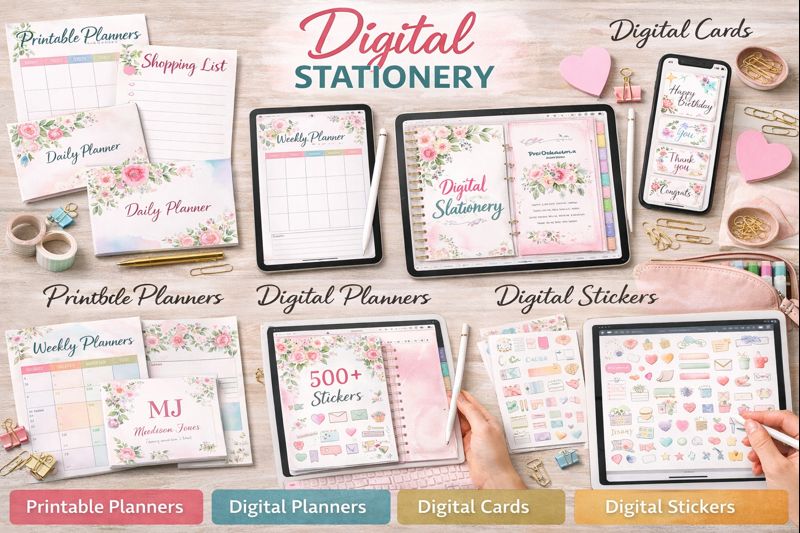
1. Digital Stationery Products
Includes:
- Digital planners
- Printable journals
- Study templates
- Wedding templates
Selling price: ₹299
Creation cost: ₹40 (time/software)
Platform fee: ₹30
Net margin: ~85%
Why so high?
✔ No paper
✔ No shipping
✔ Unlimited sales
Best platforms: Etsy, Gumroad, Shopify
2. Wedding Invitation Design Services
Custom invitation design + printing.
Package price: ₹15,000
Printing: ₹3,500
Design time: ₹1,500
Net margin: ~70%
Why profitable:
✔ Premium market
✔ Custom pricing
✔ Emotional value
3. Calligraphy & Hand Lettering
50 wedding envelopes: ₹5,000
Materials: ₹500
Time cost: ₹1,000
Net margin: 70%
Medium–High Margin Products (50–70%)
4. Handmade Journals
Selling price: ₹1,200
Materials: ₹350
Labour: ₹200
Margin: ~65%
5. Custom Stickers
Sticker pack: ₹150
Printing: ₹40
Packaging: ₹15
Margin: ~60%
6. Luxury Stationery
Premium paper, leather covers, gold foiling.
Margin: 60–75%
7. Personalized Planners
Selling price: ₹800
Blank planner: ₹180
Customization: ₹80
Margin: ~65%
Medium Margin Products (40–60%)
8. Print-on-Demand Stationery
Selling price: ₹400
POD base cost: ₹180
Platform fee: ₹60
Margin: ~40%
9. Greeting Cards
Selling price: ₹100
Printing + envelope + packaging: ₹40
Margin: ~60%
Lower Margin Products (20–45%)
10. Wholesale Office Supplies
Selling price: ₹500
Cost: ₹350
Margin: 30%
11. Branded Stationery Reselling
Margins only 15–30%
Brand controls pricing.
3. Cost Components That Affect Your Margin
| Cost Component | What It Includes | Typical Cost Range | Impact on Profit Margin | How to Control It |
|---|---|---|---|---|
| Raw Materials | Paper, covers, ink, binding, embellishments | ₹50 – ₹500 per unit | High | Buy in bulk, negotiate suppliers |
| Printing & Production | Printing, cutting, binding, lamination | ₹5 – ₹100 per unit | High | Use batch production |
| Packaging | Boxes, envelopes, branding, wrapping | ₹10 – ₹80 per order | Medium | Use standard packaging |
| Platform Fees | Etsy, Amazon, Shopify payment fees | 8% – 20% of selling price | High | Drive direct website sales |
| Marketing & Ads | Social media ads, influencer, SEO | 5% – 20% of revenue | Medium | Focus on organic traffic |
| Shipping & Logistics | Courier, returns, damages | ₹30 – ₹150 per order | Medium | Use shipping aggregators |
| Overhead Costs | Electricity, internet, storage | ₹1,000 – ₹10,000/month | Medium | Work from home |
| Labor & Time | Design, production, customer support | ₹150 – ₹1,000 per hour | High | Automate & outsource |
| Inventory Holding | Unsold stock, storage loss | 2% – 10% of stock value | Medium | Maintain lean inventory |
| Equipment | Printer, cutter, laminator | ₹10,000 – ₹2,00,000 (one-time) | Low (long-term) | Buy used equipment |
Direct Costs (COGS)
- Paper: ₹50–₹500
- Printing: ₹5–₹50
- Binding: ₹10–₹100
- Packaging: ₹10–₹80
- Decoration: ₹5–₹50
Indirect Costs (Overhead)
- Electricity: ₹500–₹2,000/month
- Internet: ₹500–₹1,000
- Equipment: ₹1,000–₹3,000
- Storage: ₹0–₹5,000
Platform Fees
- Etsy: ~10%
- Amazon: 15–20%
- Shopify: ₹2,000/month + 2%
Shipping
- Domestic: ₹30–₹100
- Returns: 2–5% revenue
Your Time (Most People Ignore This!)
Design time: ₹200–₹1,000/hour
Production time: ₹150–₹500/hour
Real Cost Example (Handmade Journal)
Selling price: ₹1,000
Materials: ₹450
Platform fee: ₹65
Shipping: ₹50
Packaging: ₹25
Marketing: ₹100
Labour (2 hrs × ₹200): ₹400
Total cost: ₹1,090 → LOSS!
This is why pricing must include ALL costs.
4. Margin Differences by Business Model
| Model | Margin | Pros | Cons |
|---|---|---|---|
| Home-based | 60–75% | Low cost | Limited scale |
| Retail store | 30–50% | Walk-in sales | High rent |
| Online-only | 45–70% | Global reach | Platform fees |
| POD | 40–55% | No inventory | Lower control |
| Wholesale | 25–40% | Bulk orders | Low margins |
5. How to Calculate Your Stationery Margin
Step-by-Step Method
- Add all direct costs
- Add indirect cost per unit
- Add your time value
- Calculate total cost
- Apply margin formula
Example:
Direct cost = ₹210
Indirect cost = ₹150
Labour = ₹450
Total cost = ₹810
For 60% margin:
Selling price = ₹810 ÷ 0.40 = ₹2,025
6. Pricing Strategies to Maximize Margins

Cost-Plus Pricing
Cost × 3 = Price
Value-Based Pricing
Charge for perceived value
(works for weddings, luxury)
Premium Pricing
Position as luxury brand
Margins: 65–80%
Bundle Pricing
Increase average order value
Tiered Pricing
Basic, Premium, Deluxe versions
7. How to Increase Your Stationery Margins by 20–40%
Reduce Material Costs
- Buy in bulk (20–40% saving)
- Buy directly from manufacturers
- Negotiate supplier rates
Increase Perceived Value
- Better branding
- Premium packaging
- Add personalization
- Limited editions
Optimize Production
- Batch production
- Automation tools
- Outsource low-value work
Improve Product Mix
- Focus on top 20% products
- Drop low-margin items
- Add digital products
Reduce Platform Fees
- Build own website
- Drive direct Instagram sales
8. Real Margin Case Studies
Digital Planner Business
Price: ₹399
Margin: 77%
Monthly profit: ₹92,000+
Wedding Invitation Studio
Order value: ₹12,000
Margin: 52%
Monthly profit: ₹50,000+
Sticker Business
Pack: ₹180
Margin: 58%
Monthly profit: ₹52,000+
9. Common Margin Mistakes
❌ Not counting your time
❌ Forgetting platform fees
❌ Underpricing to get customers
❌ Free shipping without adding cost
❌ Saying yes to every custom order
❌ No monthly profit tracking
10. Margin Benchmarks by Business Stage
| Stage | Margin | Revenue | Net Profit |
|---|---|---|---|
| 0–6 months | 40–50% | ₹20k–₹50k | ₹8k–₹25k |
| 6–18 months | 50–65% | ₹50k–₹1.5L | ₹25k–₹97k |
| 18+ months | 60–75% | ₹1.5L–₹5L | ₹90k–₹3.7L |
11. Tools to Track Margins
- Google Sheets profit tracker
- Zoho Books
- Wave Accounting
- Zoho Inventory
- Craftybase
Track weekly:
✔ Gross margin
✔ Net margin
✔ Best products
✔ Worst products
Conclusion
Your stationery business margin decides whether your business becomes:
✔ A profitable brand
✔ A scalable company
✔ A long-term income source
Or just another stressful job.
Stationery is a high-margin industry — but only if you price smart, track costs, and build value.
Whether you run a stationery shop from home, an online stationery business, or a handmade brand — mastering margins is your biggest competitive advantage.
FAQs
What are typical gross and net margins for stationery stores?
Most stationery stores earn 40–70% gross margin and 15–35% net profit margin.
What is the margin difference between wholesale and retail stationery sales?
Wholesale stationery earns 10–20% net margin, while retail stationery stores earn 20–35% net margin.
How do I calculate markup to achieve a target net margin?
Use this formula: Selling Price = Total Cost ÷ (1 − Target Margin).
Which stationery product categories have the highest margins?
Digital planners, custom wedding stationery, stickers, and personalized journals offer the highest margins (60–95%).
How does location and rent affect stationery store profitability?
High-rent locations reduce stationery store profit margins by 10–20% compared to low-rent or home-based stores.

Ankit Singh brings more than 8 years of experience in the stationery industry, with strong expertise in wholesale markets, stationery products, and both offline and online sales. His practical market exposure combined with deep digital knowledge helps business owners plan better, avoid common mistakes, and build sustainable stationery businesses.
Leave a Reply